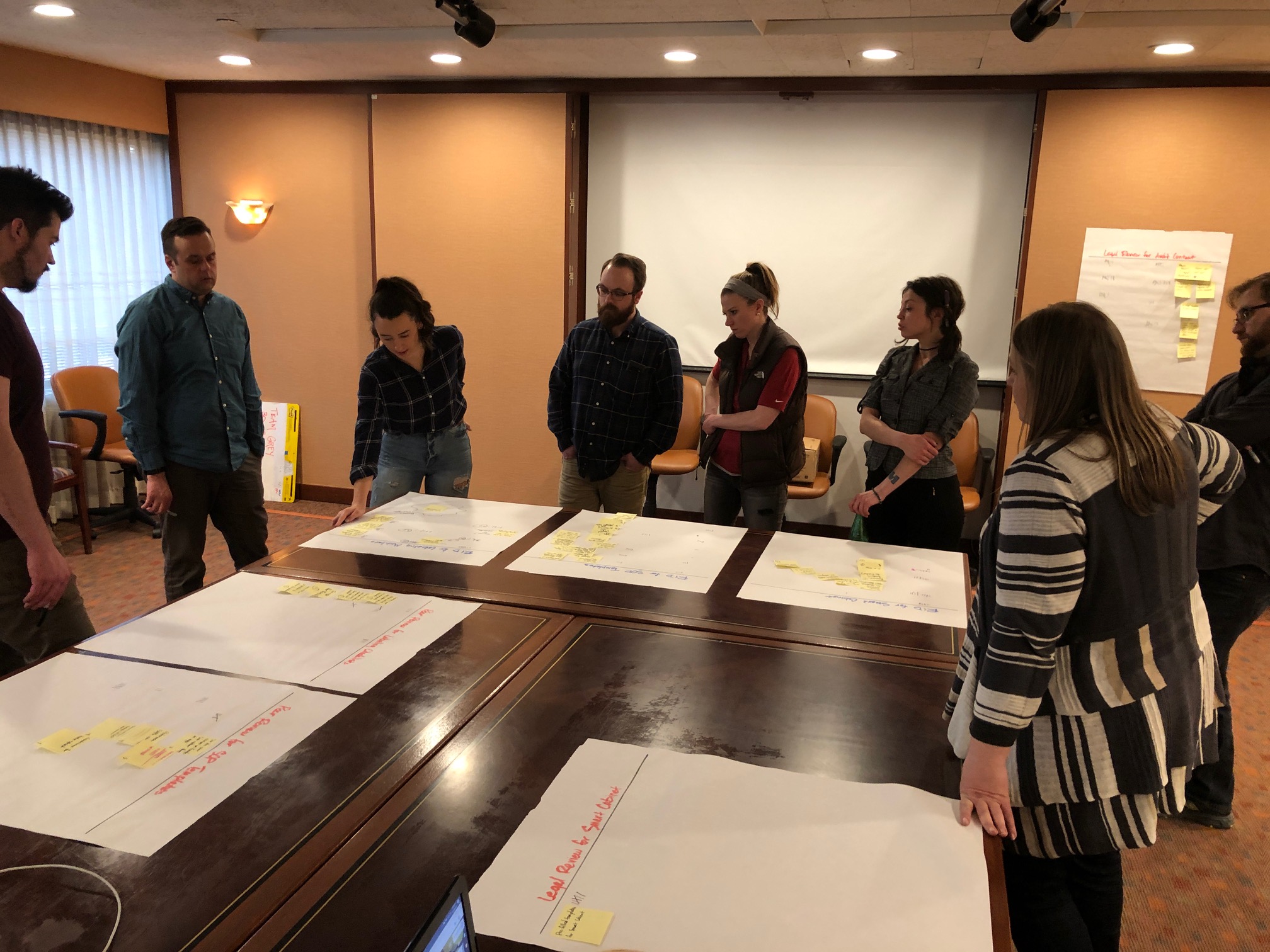
On March 22, 2019, the Regulatory Affairs team held its first-ever department retreat. It was an all-day brainstorming session facilitated by organizational design expert Krista Points.

Team-Building Exercise
After some introductions, the morning began with a team-building exercise using the Myers-Briggs Type Indicator. Despite some concerns about the nature of the survey (Krista had us take the MBTI ahead of time), we all agreed that our personality profiles were accurate.
We learned some things we already knew – almost all of us are introverts – and some things we didn’t know. For example, our individual profiles combine to create certain tendencies as a team. Those tendencies can be strengths or weaknesses depending on the situation. Awareness can help us navigate those situations more effectively.
I’ve used the MBTI maybe 20+ times now. It has its drawbacks, but the advantages are clear. I personally like how it articulates a person’s attributes, even the not-so-positive attributes. Using my profile as an example:
- My contribution as a leader comes from quietly organizing and maintaining order by providing logic and common sense.
- I may irritate team members by being too task-focused and rule-bound.
- I may be irritated by team members who propose untried, impractical, or imprecise plans of action.
- I can maximize my effectiveness by being more outwardly inclusive and appreciative of others.
After reading that, all I can say is, “Yep, that’s me!”
Reexamining Our Development Stages
We spent the largest block of our time reexamining how we create the four content types: Audit Content, Smart Cabinet, SOP Templates, and Labeling Checklists. The framework of our Content Development Life Cycle (CDLC) is solid, but we felt our execution of the various stages within the framework could be improved. It would take too long to list all of the ideas, but here’s a good example.

In-App Peer Reviews
For somewhat obvious reasons, peer reviews have typically been done outside of the app. It’s much easier to analyze a large amount of content when it’s organized in a spreadsheet or a document. We can run spell checks, sort by any field in the spreadsheet, search for duplicate phrases, identify formatting inconsistencies, perform find-and-replace routines, and so on.
But the one shortcoming of our current peer review process is that it cannot fully replicate the user experience. As a result, many of the oddities and bugs that have found their way into production have had more to do with the way the user is seeing the content.
To eliminate this shortcoming, one of our major objectives in the coming months is to conduct in-app peer reviews. The idea is to review our content through the same lens as a user.
While it sounds simple, we’ve identified at least two significant hurdles. One is that many of the quality control checks in the current peer review stage need to be moved to the drafting stage. Another hurdle is that we need a way to configure, import, and test this content before it goes into production. Now that we know what we want to do, we’ll take the next couple of weeks to figure out how to do it!
Emphasizing Quality
We acknowledged there are several dimensions of quality and treated each of them separately.
First, Krista walked us through the quality triangle. It’s a project management principle that says quality is a function of three variables: time, cost, and scope. It set the stage for a deeper discussion about other dimensions of quality.
We identified an internal need to measure quality at a more granular level. To meet this need, we came up with several ideas to create checklists that force drafters to account for the critical steps and for reviewers to deliver feedback in standard ways.
We also identified an external need to assure clients we are meeting a “quality bar” at a more macro level. We generated a couple of ideas on how we can do this, but we obviously need help from the client-facing team to make sure we land on something that is perceived as quality by our clients. More on that as the initiative takes shape.

Reinforcing Monitoring
While this session focused on monitoring local jurisdictions for changes in regulations, it also covered several related topics. Perhaps the most complex of those topics was the challenge of handling year-end updates at the state level.
For those that weren’t aware, we received several state updates near the end of 2018. Everybody knows about the CA roller coaster, but we also got changes from CO, MA, MD, MI, and OR. On top of those, we had commitments to launch OH, PA, and FL in the December-to-February timeframe. And we were also trying to tackle some local jurisdictions.
Whatever 2018 was, the end of this year will be at least twice as challenging! Thankfully, we have some time to prepare. Among the ideas discussed and not yet prioritized:
- Drafting against proposed regulations. We’ve always waited for final regulations to eliminate the risk of having to re-draft, but maybe we need to make exceptions.
- In the case of California, drafting by category rather than by agency. Theoretically, this should eliminate the work required to remove duplicates when agencies overlap their requirements.
- Using the analogy of CPAs working overtime during “tax season,” maybe we just need to work overtime during “update season.”
- Hiring temporary, part-time help. We talked about entry-level help to perform certain QA tasks. We also talked about hiring attorneys to help with legal reviews.
Conclusion
We wrapped things up over drinks at Rory’s Tavern. Early on, we naturally continued the conversations from the retreat, but our attention gradually turned to Reefer Madness and weekend plans.
I’m sure many are curious about how and when the ideas we generated at the retreat will get implemented. Me too! I’m in the process of organizing the ideas into initiatives that will be prioritized and assigned over the course of the next two weeks. Beyond that, each initiative will carry its own timeline for implementation based on complexity and the resources needed. Stay tuned!
Seems like an incredibly enlightening exercise. We’ll be very excited to see these plans come into place, and obviously to help where needed!
Very cool, guys! Thanks for sharing this. I know a few of us that didn’t attend were wondering what it was all about.
Small suggestion: You guys should do trust falls next time. And record them.